

HOUSE TOUR #25, June 2026
Art viewing
The Art of Two - Introducing an Artist Couple
In our 25th newsletter, we take a look at the sculptor couple Sylvia Hagen and Werner Stötzer, featured in the current exhibition "The Art of Two – Between Autonomy and Collaboration," in which we present works by 18 artist couples.
Two Lives, Two Visual Languages
There are works by artist couples that converse with one another, even in silence.
Sylvia Hagen and Werner Stötzer lived and worked in the Oderbruch region for decades. Amidst fields, waterways, and vast skies, they created sculptures that tell stories of the human condition: of people searching, walking, and revealing their vulnerability. Their work speaks of setting out and standing still, of intimacy and solitude, and of the traces a life leaves behind.
Hagen’s figures seem to have emerged from the earth itself. Rough, tentative, and imbued with a quiet persistence, they assert their presence in the space around them. Stötzer’s bodies condense into signs and fragments of a story that is never fully told.
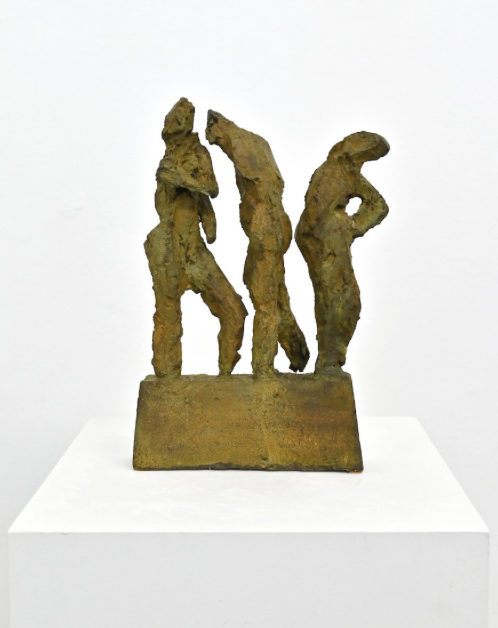
In this exhibition, their works meet in a silent dialogue. It almost seems as though Stötzer’s "Wegzeichen" (Signpost, 1992) and Hagen’s "Wanderer namenlos" (Nameless Wanderer, 1992) are continuing a conversation begun more than thirty years ago.
A waymarker promises orientation. Yet, in creating his cast-stone figure, Stötzer does not fashion an obvious sign - like an arrow or a standard marker - but rather depicts a human torso. His torso appears focused and steadfast, a solid anchor point in space. Here, orientation does not seem to come from the outside but rather from within the individual - a being formed by a unity of memories, experiences, and instincts. The signpost points not to a physical location, but to an inner stance.
In contrast, Hagen’s bronze sculpture "Wanderer namenlos" speaks of movement and openness. The three figures appear to be setting out on different paths or still searching for their direction. They embody the experience of being on a journey - the search for orientation, openness to change, and the diversity of possible paths in life.
Both sculptures were created in 1992, shortly after the fall of the Berlin Wall. At a time when familiar points of reference were dissolving for many people in East Germany and life paths had to be redefined, the works take on an additional social dimension.
Thus, the two sculptures can be read as two sides of the same question: How do we find our way? While Hagen’s wanderers seem to seek their answers in the outside world, Stötzer’s signpost illustrates that we often carry our sense of direction within ourselves.
The unique power of this juxtaposition lies not in the search for commonalities, but in the acknowledgment of differences. Two artistic voices listening to one another. Two perspectives on the world. Two ways of viewing the human being.
And in between, there is us: invited to follow the traces.
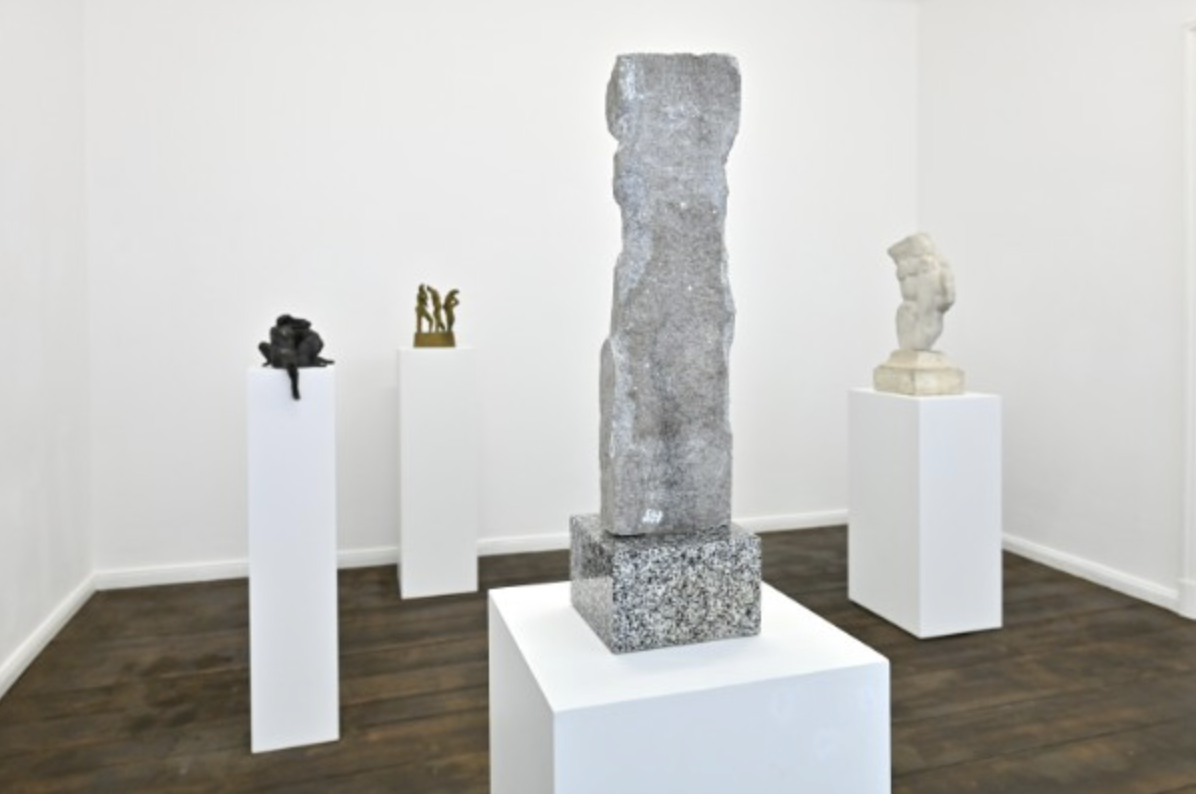
Exhibition view: Sylvia Hagen and Werner Stötzer. Pictures: Michael Lüder.
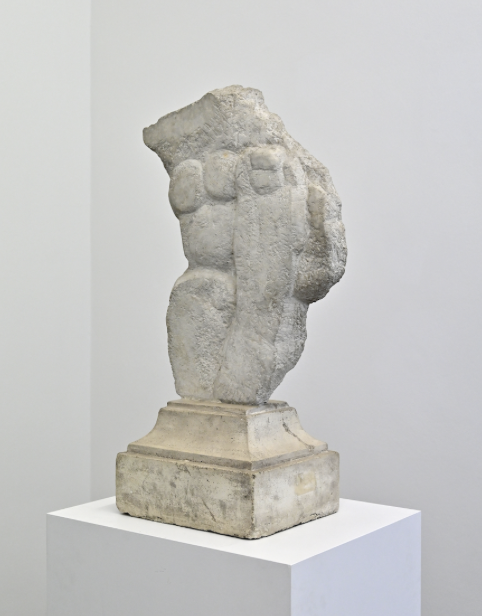
links: Werner Stötzer: Wegzeichen, 1992 Steinguss (Marmorbestandteile), 54 x 41 x 5 cm, Kunstsammlung der Berliner Volksbank K 602, © VG Bild-Kunst, Bonn 2026;
rechts: Sylvia Hagen: Wanderer namenlos, 1992, Bronze, 33 x 23 x 7,5 cm, Kunstsammlung der Berliner Volksbank K 487. Fotos: Michael Lüder